

 I experimented with various placement and size of the text. What I've done here is landscape showing the topic area in the positive side. This is to create the awareness of the importance of conserving rice supply for its abundance in future. The Future Is In Your Hands shows that it is our responsibility for our own future. I'm thinking whether I should add the outline of hands cupping the positive side while the outer part is the negative side to add more contrast.
Monday, September 8, 2008
Sketches
I experimented with various placement and size of the text. What I've done here is landscape showing the topic area in the positive side. This is to create the awareness of the importance of conserving rice supply for its abundance in future. The Future Is In Your Hands shows that it is our responsibility for our own future. I'm thinking whether I should add the outline of hands cupping the positive side while the outer part is the negative side to add more contrast.

Sunday, September 7, 2008
Ideation
Statement:
'Rice' To The Future, the Future Is In Your Hands
I use the word Rice in place of Rise in the phrase "Rice to the Future". This statement calls everyone to act now for the sake of our own future. The phrase "The Future Is In Your Hands" is to make people realize and face the fact that our future cannot be decided by anyone but ourselves. If we rise to the occasion and take actions now, we can ensure life in abundance. To create awareness to the shortage of rice supply, I make the poster showing both positive and negative image in landscape form. Paddy field with ripe stalks inside the outline of a pair of hands close together is to show the ideal situation that we must preserve; instead of drought drying up the irrigation and heat consuming the field outside the outline of hands. The main idea here is to create an awareness of the importance of conserving rice supply to ensure its abundance in future.
Assignment 3- References


 http://www.thericedrive.blogspot.com/
" 'Rice' to the occassion" uses the word rice in place of rise.
this will be the guide to the message potrayed in my poster to create awareness that we must act now, for a better future.
 http://sonche.com
I like how the font colour and design gives a soothing and protective feeling.
 http://www.breedingracing.com
I'm planning to use this layout with the top part as the message and the bottom part as main title.
 http://www.plexoft.com/
I'll use this perspective on the paddy field.

 http://www.panoramio.com/
 http://www.rainforestours.com/
Saturday, September 6, 2008
Background Research
In Australia, years of drought have seen rice growers' water allocations slashed, and only a handful of producers have been able to harvest crops.
Some supermarket shoppers in America are facing rice rations - as a global shortage of the grain prompts retailers to restrict supplies.
http://news.sbs.com.au/worldnewsaustralia/global_rice_shortage_sparks_panic_545601
~~~~~~~~~~~~~~~~~~~~~~~~~~~~~~~~~~~~~~~~~~~~~~~~~~~
Crop shortfalls from natural disasters
Several distinct weather- and climate-related incidents have caused disruptions in crop production. Perhaps the most influential is the extended drought in Australia, in particular the fertile Murray-Darling Basin, which produces large amounts of wheat and rice. The drought has caused the annual rice harvest to fall by as much as 98% from pre-drought levels. Australia is historically the second-largest exporter of wheat after the United States, producing up to 25 million tons in a good year, the vast majority for export. However, the 2006 harvest was 9.8 million. Other events that have negatively affected the price of food include the 2006 heat wave in California's San Joaquin Valley, which killed large numbers of farm animals, and unseasonable 2008 rains in Kerala, India, which destroyed swathes of grain. Scientists have stated that several of these incidents are consistent with the predicted effects of climate change.
Sundquist points out that large areas of croplands are lost year after year, due mainly to soil erosion, water depletion and urbanisation. According to him "60,000 km2/ year of land becomes so severely degraded that it loses its productive capacity and becomes wasteland", and even more are affected to a lesser extend, adding to the crop supply problem. Additionally, agricultural production is also lost due to water depletion.
http://en.wikipedia.org/wiki/Food_price_crisis#Crop_shortfalls_from_natural_disasters
Sunday, August 17, 2008
Assignment 2- Final
Title: Rice Abundance

Ideation:
This is my final illustration for Assignment2. I chose to draw a section of a vast paddy field to show that we should preserve our rice supply so that there'll be plenty for the population. The paddy stalks here are bended and the grains are ripe, signifying the richness and abundance of rice we ought to have. Not only that, I drew unpolluted water and clear blue sky to show that we must preserve mother nature for a better future.
~~~~~~~~~~~~~~~~~~~~~~~~~~~~~~~~~~~~~~~~~~~~~~~~~~~~~~~~~~~~~~
smaller area of Global Warming: Global Rice Shortage
Paddy growth depends on water supply, but world's water freshwater supply is running out. Moreover, global warming is affecting this by causing drought spells frequently. Other causes affecting rice supply are the erosion and the loss of organic matter in soils, desertification, the loss of ozone from the stratosphere and its increase in the troposphere, acid rain, the decrease in biological diversity, air pollution, and flooding caused by deforestation.
We must save mother nature for our survival in the future. Actions must be taken NOW as the rice supply worldwide is diminishing while population increases. Therefore, I draw an illustration of abundance of rice and the clean environment to create an awareness amongst the people.
References:
http://www.newscientist.com/
http://www.irri.org/
http://www.nytimes.com/
~~~~~~~~~~~~~~~~~~~~~~~~~~~~~~~~~~~~~~~~~~~~~~~~~~~~~~~~~~~~~
Colours:
Yellow = Symbolizes ripe rice grains to signify abundance.
Green = In the leaves and stems of paddy stalks. Healthy plants signifying clean environment.
Brown = In the ground next to irrigation, and soil of the field.
Blue = The skies are blue to create the feeling of calmness and to show that the air is not polluted.
White = White clouds instead of dirty air and smoke to represent clean atmosphere
Clear water with reflection= unpolluted water running through the irrigation.
~~~~~~~~~~~~~~~~~~~~~~~~~~~~~~~~~~~~~~~~~~~~~~~~~~~~~~~~~~~~~~~~
Tools used:
-Pen Tool-
-Brush tool-
-Pencil Tool-
-Ellipse Tool-
-Live Paint Bucket-
-Gradient-
-Selection Tool-
-Direct Selection Tool-
-Zoom Tool-
-Flare Tool-
-Rotate Tool-
-Reflect Tool-
-Scale Tool-
-Warp Tool-
-Crystallize Tool-
-Wrinkle Tool-
-Twirl Tool-
-Free Transform Tool-
-Blur Tool-
-Blend Tool- (finally changed because it takes up too much memory)
[Might edit here and there when I feel like it. So it's not really final]
Step by Step Process
added shadows but realise it's in different direction from sun. editing now
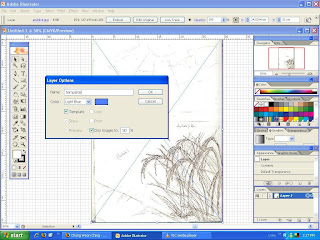
First, I dragg my scanned sketch into illustrator CS2. A few adjustments of position and size are done. Then, I set the layer as template so that it won't appear in print.
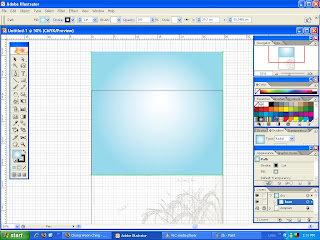
Then I make a new layer named "sky". Under "sky", I make a sublayer for the "base". Then I use Pen Tool(P) to draw the frame. To colour it I use Gradient Tool(G) and set it as radial using white and a light shade of blue to make it look like sunshine.
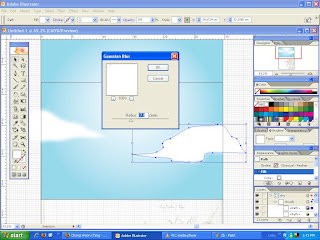 Next I make a new sublayer under "sky" named "clouds". I use Pencil Tool(N) to draw the clouds. Then I use Effects>>Blur>>Gaucassion Blur and set it at 7.0 pixels. Next, I use Selection Tool(V) to adjust the size.
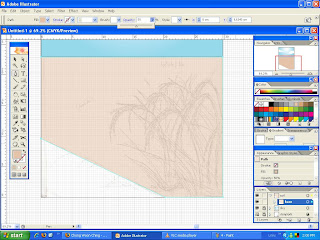
After that, I lock the "sky" layer and make a new layer named "soil". This will be a section of my paddy field. I create a new sublayer named "base". Then, I use Pen Tool(P) and fill it with the colour latte. I set the opacity as 50% so that i can see my sketch below.
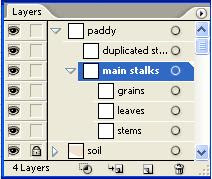 I created layers and sublayers for my paddy field first so that it'll be organized. Will be working on this a long time. Posting this in case i forgot to screenshot later [too engaged in the process -_-"]
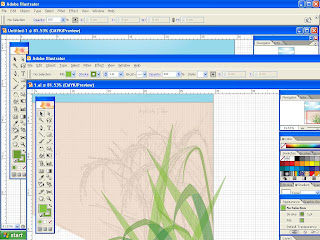 As I expected, I did get too absorbed in the process. XD What i done here is under the layer "paddy", sublayer "main stalk1", i use Pen Tool(P) to draw the stem and leaves' outlines and veins. Then i use Live Paint Bucket(K) to fill in the colours. After that, i duplicate the leaves under "main stalk1" and paste them on "main stalk2" and "main stalk3". Next using Object>>Transform to rotate and resize the leaves to create a variation. Phew.. now that the main leaves are almost done, I'll start on "grains"
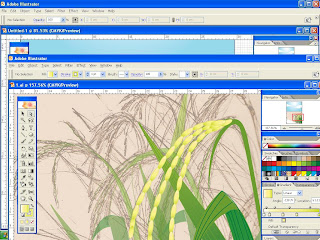 For the rice grains on the paddy stalks, I use Ellipse Tool(L). I use Gradient(G) for the colour in linear setting. Then i duplicate one single grain into many to form a chain. Next, I use Direct Selection Tool (A) to group the chain for easier selection. More chains are duplicated and using Object>>Transform>>Rotate to create variation.
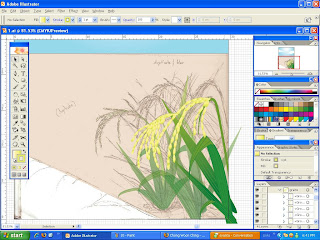 More duplicating... -happy with result of 2 stalks- Then, *zooms out*...
[practically fainted]
I have a looooong way to go.... -_-""
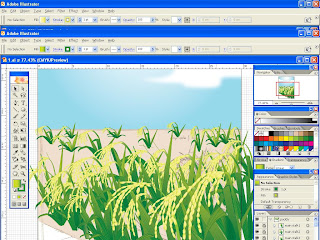 *runs to a wall and bangs head* X_x
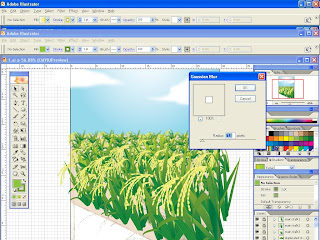 -dead- Anyways, more duplications. I vary the sizes with Selection Tool(V) and shapes using Warp Tool(Shift+R). Along this process, I made the leaves lighter and the stalks blurer using Effects>>Blur>>Gaucassion Blur, the further the paddy stalks are. Half-dead now. Wow, time flies! Need to grab a bite.
To be continued~~~
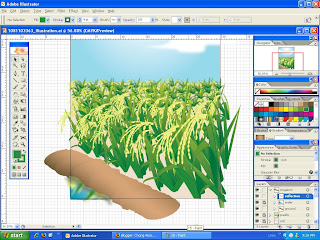 back. I make a new layer named "irrigation" and sublayers "ground" and "water". For the ground, I experimented with Blend Tool. Then I use gradient for the colour. I use Wrinkle Tool for the sides of the ground. Next, I use Pen Tool(L) for the base colour of water and Warp Tool for the effect I want. Then, I make a new sublayer named "reflection" for the reflection of paddy on surface of water. Using Pen Tool(P), I draw the basic lines and then blurring it using Gaucassian Blur. For extra effect I use Twirl Tool.
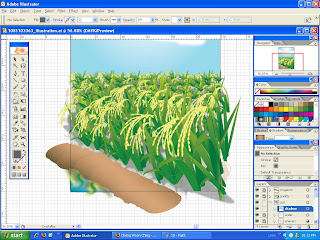 Under the layer "soil", I make sublayers named "uneven", "shadow" and "water". Using Brush Tool and chalk brush, I make uneven lines around the base of the stalks. Then I put a layer of water on top with lower opacity so that it is see-through. Next, I use Ellipse Tool and Crystallize Tool for the shadows.
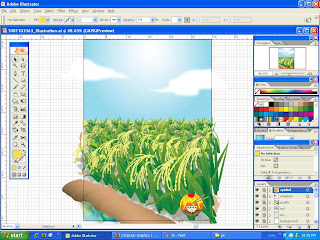 Added my Symbol.
Is there anything to add?
Ah wells.. Too tired now anyways. Good night people.
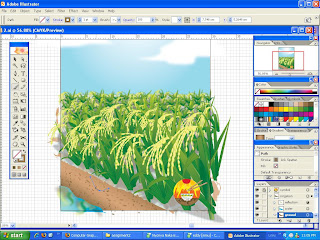 Apparently, my illustrator lag after I use Blend Tool. So I check the file size.
.....54MB??!!!
Alright time for drastic action. Don't want my file lag the lecturer's computer and get me a 0%.
I deleted the Blend Tool layer and use Pen Tool instead with Gradient.
Then I use Brush Tool with ink splatter brush for texture.
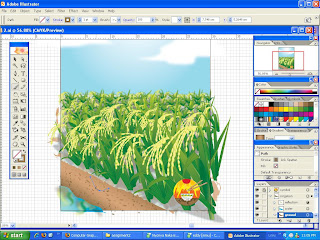 Told you I'll be editing and editing XDD. Anyways I added reflection of the paddy stalks on the surface of water on the soil. First I Reflect the stalk and set it at Copy. And reduce the opacity.
Ta-daaa~ almost done~ Hopefully XD
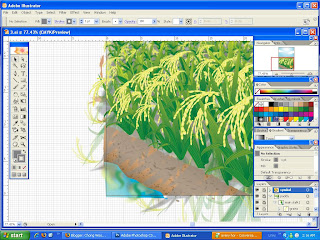 Added shadows and I shall call it a day [looks at time] 2:20am @_@

First, I dragg my scanned sketch into illustrator CS2. A few adjustments of position and size are done. Then, I set the layer as template so that it won't appear in print.

Then I make a new layer named "sky". Under "sky", I make a sublayer for the "base". Then I use Pen Tool(P) to draw the frame. To colour it I use Gradient Tool(G) and set it as radial using white and a light shade of blue to make it look like sunshine.
 Next I make a new sublayer under "sky" named "clouds". I use Pencil Tool(N) to draw the clouds. Then I use Effects>>Blur>>Gaucassion Blur and set it at 7.0 pixels. Next, I use Selection Tool(V) to adjust the size.
After that, I lock the "sky" layer and make a new layer named "soil". This will be a section of my paddy field. I create a new sublayer named "base". Then, I use Pen Tool(P) and fill it with the colour latte. I set the opacity as 50% so that i can see my sketch below.
 I created layers and sublayers for my paddy field first so that it'll be organized. Will be working on this a long time. Posting this in case i forgot to screenshot later [too engaged in the process -_-"]
 As I expected, I did get too absorbed in the process. XD What i done here is under the layer "paddy", sublayer "main stalk1", i use Pen Tool(P) to draw the stem and leaves' outlines and veins. Then i use Live Paint Bucket(K) to fill in the colours. After that, i duplicate the leaves under "main stalk1" and paste them on "main stalk2" and "main stalk3". Next using Object>>Transform to rotate and resize the leaves to create a variation. Phew.. now that the main leaves are almost done, I'll start on "grains"
 For the rice grains on the paddy stalks, I use Ellipse Tool(L). I use Gradient(G) for the colour in linear setting. Then i duplicate one single grain into many to form a chain. Next, I use Direct Selection Tool (A) to group the chain for easier selection. More chains are duplicated and using Object>>Transform>>Rotate to create variation.
 More duplicating... -happy with result of 2 stalks- Then, *zooms out*...
[practically fainted]
I have a looooong way to go.... -_-""
 *runs to a wall and bangs head* X_x
 -dead- Anyways, more duplications. I vary the sizes with Selection Tool(V) and shapes using Warp Tool(Shift+R). Along this process, I made the leaves lighter and the stalks blurer using Effects>>Blur>>Gaucassion Blur, the further the paddy stalks are. Half-dead now. Wow, time flies! Need to grab a bite.
To be continued~~~
 back. I make a new layer named "irrigation" and sublayers "ground" and "water". For the ground, I experimented with Blend Tool. Then I use gradient for the colour. I use Wrinkle Tool for the sides of the ground. Next, I use Pen Tool(L) for the base colour of water and Warp Tool for the effect I want. Then, I make a new sublayer named "reflection" for the reflection of paddy on surface of water. Using Pen Tool(P), I draw the basic lines and then blurring it using Gaucassian Blur. For extra effect I use Twirl Tool.
 Under the layer "soil", I make sublayers named "uneven", "shadow" and "water". Using Brush Tool and chalk brush, I make uneven lines around the base of the stalks. Then I put a layer of water on top with lower opacity so that it is see-through. Next, I use Ellipse Tool and Crystallize Tool for the shadows.
 Added my Symbol.
Is there anything to add?
Ah wells.. Too tired now anyways. Good night people.
 Apparently, my illustrator lag after I use Blend Tool. So I check the file size.
.....54MB??!!!
Alright time for drastic action. Don't want my file lag the lecturer's computer and get me a 0%.
I deleted the Blend Tool layer and use Pen Tool instead with Gradient.
Then I use Brush Tool with ink splatter brush for texture.
 Told you I'll be editing and editing XDD. Anyways I added reflection of the paddy stalks on the surface of water on the soil. First I Reflect the stalk and set it at Copy. And reduce the opacity.
Ta-daaa~ almost done~ Hopefully XD
 Added shadows and I shall call it a day [looks at time] 2:20am @_@
Assignment 2- Sketches
Sketches done last week. My scanner was being evil. Anyways, a few rough sketches of layouts.

trying different views- closeup of paddy

the one on the left is wrong for assignment 2 XD maybe more appropriate for assignment 3.


trying different views- closeup of paddy

the one on the left is wrong for assignment 2 XD maybe more appropriate for assignment 3.

same thing. more suitable as assignment 3. need to focus on paddy ><..
 gonna do this layout for assignment 2
so that i can use part of it in assignment 3 by duplicating it.
then my paddy field in assignment 3 will look super detailed XD..
 gonna do this layout for assignment 2
so that i can use part of it in assignment 3 by duplicating it.
then my paddy field in assignment 3 will look super detailed XD..
Subscribe to:
Posts (Atom)